
Article
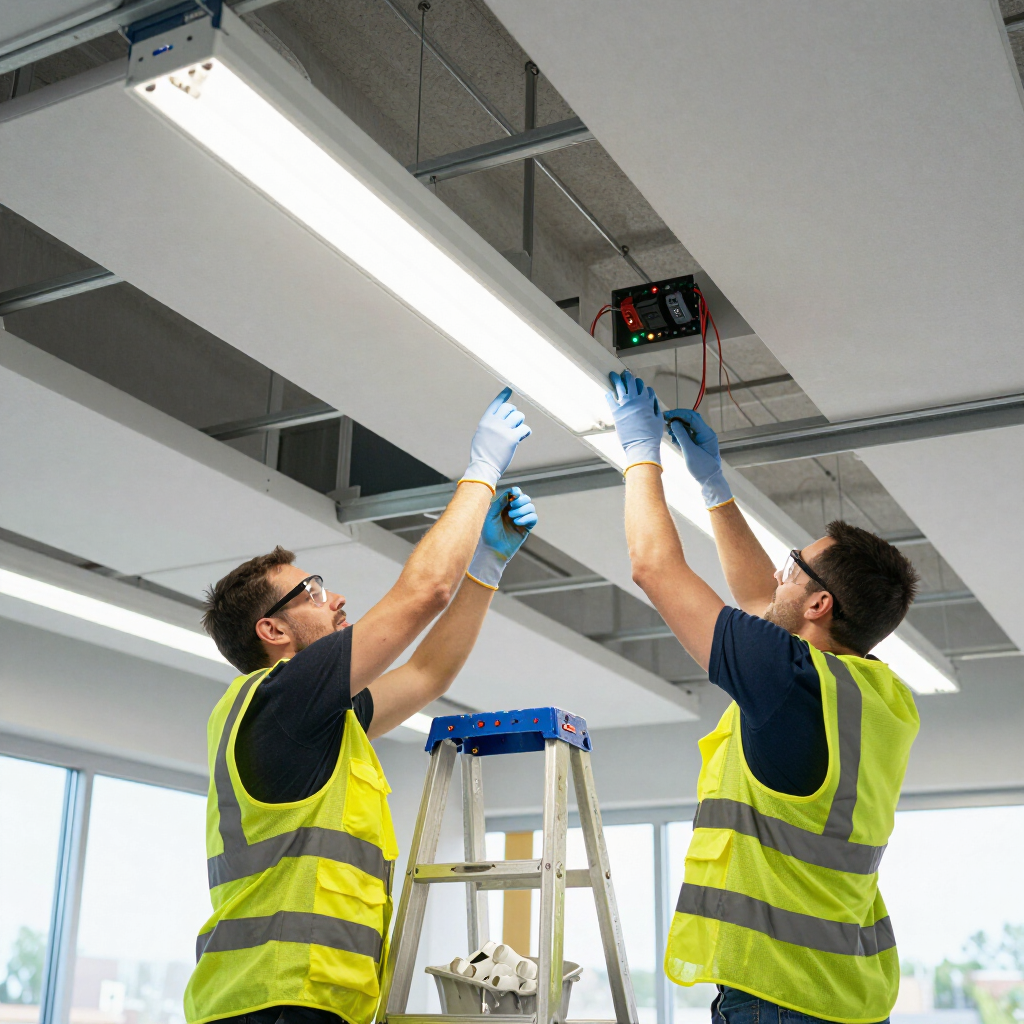
Year-end budgets and incentive deadlines create pressure. The fastest decision is rarely the best one. A structured path keeps safety, visibility, and ROI aligned. This guide provides a field-ready framework for facilities in the greater Chicago area. It compares Type A, B, C, and full fixture replacement with code, safety, controls, and utility incentives in view. It also includes labeling notes, photometric targets, and a step-by-step audit-to-install workflow. The outcome is simple: pick the right path once, install safely, hit target footcandles with low glare, and commission controls to lock in savings. Start with the decision framework Select the primary driver, then apply constraints. Primary driver: safety and code, fixture condition, controls roadmap, ROI timeline, incentives. Constraints: operating hours, mounting height, optics needs, ambient vs task layers, disruption tolerance. Mapping drivers to paths: If ballasts are recent, compatible, and fixtures are clean: Type A can be acceptable for quick wins. If ballasts are failing or nuisance-tripping: Type B or Type C avoids ballast risk. If advanced controls or networked sensors are planned: Type C or full fixture is preferred. If optics and glare are poor, or housings are degraded: full fixture replacement. Type A, B, C, and full fixture at a glance Type A (ballast-compatible LED tubes): Lowest labor if the existing ballast is on the lamp’s approved list. Faster installs and minimal rewiring. Ballast remains a failure point and can reduce net efficiency. Type B (ballast-bypass/direct-wire LED tubes): Removes ballast losses and failure risks. Requires wiring changes, polarity management for single-ended lamps, mandatory relabeling, and strong lockout/tagout discipline. Type C (external LED driver with LED lamps or light engines): Dedicated driver improves efficiency, dimming, and control stability. Strong path for networked controls and future upgrades. Requires driver mounting space and wiring updates. Full fixture replacement: New optics, glare control, integral or networked controls, longer useful life, and strong incentive eligibility. Higher material cost and more installation time. Chicago-area incentives and planning notes ComEd and regional programs typically favor solutions with higher verified savings and controls. Full fixtures and Type C systems with networked occupancy and daylight controls often score best. Type B can still qualify when wattage reduction is clear and labeling is correct. Incentive rules change; verify pre-approval, product listings, and cut sheets during scoping. Plan around year-end backlogs to avoid missing submission windows. If you manage sites in Naperville or nearby, schedule a short audit to align scope and rebates. See our commercial lighting and retrofit services for regional dispatch and planning support. Safety, code, and labeling requirements For ballast-bypass or driver work: De-energize and verify absence of voltage. Follow lockout/tagout. Use UL-listed components matched to the application. Maintain correct lampholder ratings, lead insulation, and grounding. Update wiring diagrams in the fixture when altered. Required relabeling examples: Single-line note inside housing: “Line hot to tombstone A, neutral to tombstone B. No ballast present.” Warning label at lens/door: “LED retrofit. Ballast removed. Install Type B lamps only.” Panel schedule or circuit log: “Area XYZ, fixtures F1-F24, converted to LED Type B, date, technician ID.” For Type C: Label driver make, model, input, output, and lamp count. Add a driver wiring diagram and dimming interface notes. For full fixtures: Record fixture wattage, control type, and sensor settings for commissioning records. Photometrics, optics, and glare control Design to task illuminance and uniformity, not nameplate lumens. Common interior targets: 30 to 50 footcandles for open office, 50 to 70 for classrooms and healthcare corridors, 30 to 80 for warehouses depending on task and aisle height. Use your authority having jurisdiction and IES recommendations for exact values. Uniformity: aim for max-to-min ratios that avoid hot spots. Warehouses typically benefit from narrower optics for racking aisles and wider for open pick areas. Glare: select fixtures with proper shielding, diffusers, or lens optics. High-bay lenses and louvers reduce high-angle brightness. Photometric layouts validate spacing, tilt, and optic choice. CCT and CRI by application Offices and classrooms: 3500K to 4000K, CRI 80 or higher. Retail, healthcare, art, inspection: 3500K to 4000K, CRI 90 when color accuracy matters. Industrial and warehousing: 4000K to 5000K depending on reflectance and daylight. CRI 80 is typically sufficient. Choose CCT for comfort and accuracy after you meet footcandle targets with the right optics. Controls and commissioning Controls drive savings but only when tuned. Pair occupancy sensors with timeouts matched to space use. Add daylight sensors near fenestration with proper setpoints and deadbands. For Type C and full fixtures, plan dimming interfaces and networked gateways early. Commissioning checklist: verify zoning, sensor coverage, high-end trim, setpoints, schedules, and failsafes. Document final settings. Step-by-step audit-to-install workflow Scope and safety Define objectives, constraints, operating hours, and outage windows. Capture panel schedules, fixture counts, mounting heights, and control zones. Condition assessment Inspect housings, lenses, lampholders, ballasts, wiring insulation, and grounding. Record failures, discoloration, and moisture exposure. Photometrics and design Model target footcandles and uniformity. Select optics, CCT, CRI, and control topology. Incentives and approvals Pull product listings and cut sheets. Submit pre-approval with measured baselines. Mockup Install a pilot row or zone. Confirm glare, contrast, and sensor behavior. Finalize scope Choose Type A, B, C, or full fixture based on pilot data and ROI. Install and label Perform lockout/tagout. Rewire per schematics. Apply labels and update single-line notes. Commission and verify Tune sensors and dimming. Re-run spot measurements for footcandles and uniformity. Closeout Provide as-builts, settings, warranty data, and incentive documentation. Risk matrix, common pitfalls, and mitigations Using Type A with incompatible ballasts: lamp flicker or early failure. Mitigation: verify the manufacturer’s ballast compatibility list. Type B without relabeling: future lamp misapplication and shock risk. Mitigation: mandatory internal and external labels, updated diagrams. Poor optics selection: bright spots and complaints. Mitigation: photometric layouts and pilot installs. Controls without commissioning: savings lost and nuisance shutoffs. Mitigation: documented commissioning with trims and schedules. Skipping incentive pre-approval: reduced or lost rebates. Mitigation: submit early with complete product and baseline data. Ignoring aging lampholders or brittle wiring: intermittent outages. Mitigation: replace sockets and leads during retrofit. Cost and ROI realities Costs vary by method, height, fixture condition, controls, and permit needs. Type A is typically lowest first cost, Type B and Type C are mid-range depending on rewiring and drivers, full fixtures cost more but often win on optics, controls readiness, and incentives. ROI depends on run hours and verified savings. For accurate pricing, use a site audit and quote rather than a rule of thumb. If you operate in Batavia or Naperville and need a scoped plan with incentives and commissioning, connect with our team for lighting upgrade service and energy-efficient lighting installation in Naperville. Quick FAQ Can you just replace a fluorescent tube with LED? Sometimes. Type A lamps can work if your ballast is on the approved list. Otherwise choose Type B, Type C, or full fixture. Do LED tubes need a special ballast? Type A uses compatible fluorescent ballasts. Type B does not use a ballast and needs direct wiring. Type C uses a dedicated LED driver. Can you remove the ballast and put in LEDs? Yes, with Type B. It requires safe rewiring, polarity checks, and fixture relabeling. How do you convert a 4 ft fluorescent to LED? Pick a path. Type A: verify ballast compatibility and relabel as needed. Type B: bypass ballast, wire to lampholders, add labels and diagrams. Type C: install an LED driver and matched lamps. Full fixture: replace with an LED troffer or strip and commission. What are the drawbacks of LED bypass? Risk if miswired or unlabeled, potential socket wear if lampholders are old, and no ballast to filter line noise on poor power. All are manageable with correct components, wiring, and labeling. How much does it cost to convert fluorescent to LED? It varies by path, fixture count, height, controls, and incentives. A site audit is required for a precise quote and ROI model. Summary and next step Choose the path that meets safety, light quality, and controls goals while capturing incentives. Validate ballasts for Type A, relabel for Type B, plan drivers and dimming for Type C, or replace fixtures when optics and longevity matter most. Confirm photometrics, commission controls, and document wiring and labels. Need a fast, code-true plan with incentives before year-end Cutoffs? Schedule a free audit with TCL Electrical & Lighting for a scoped retrofit and commissioning plan across the greater Chicago area. For regional support, see our pages for commercial lighting installs in Batavia and energy-efficient lighting installation in Naperville.
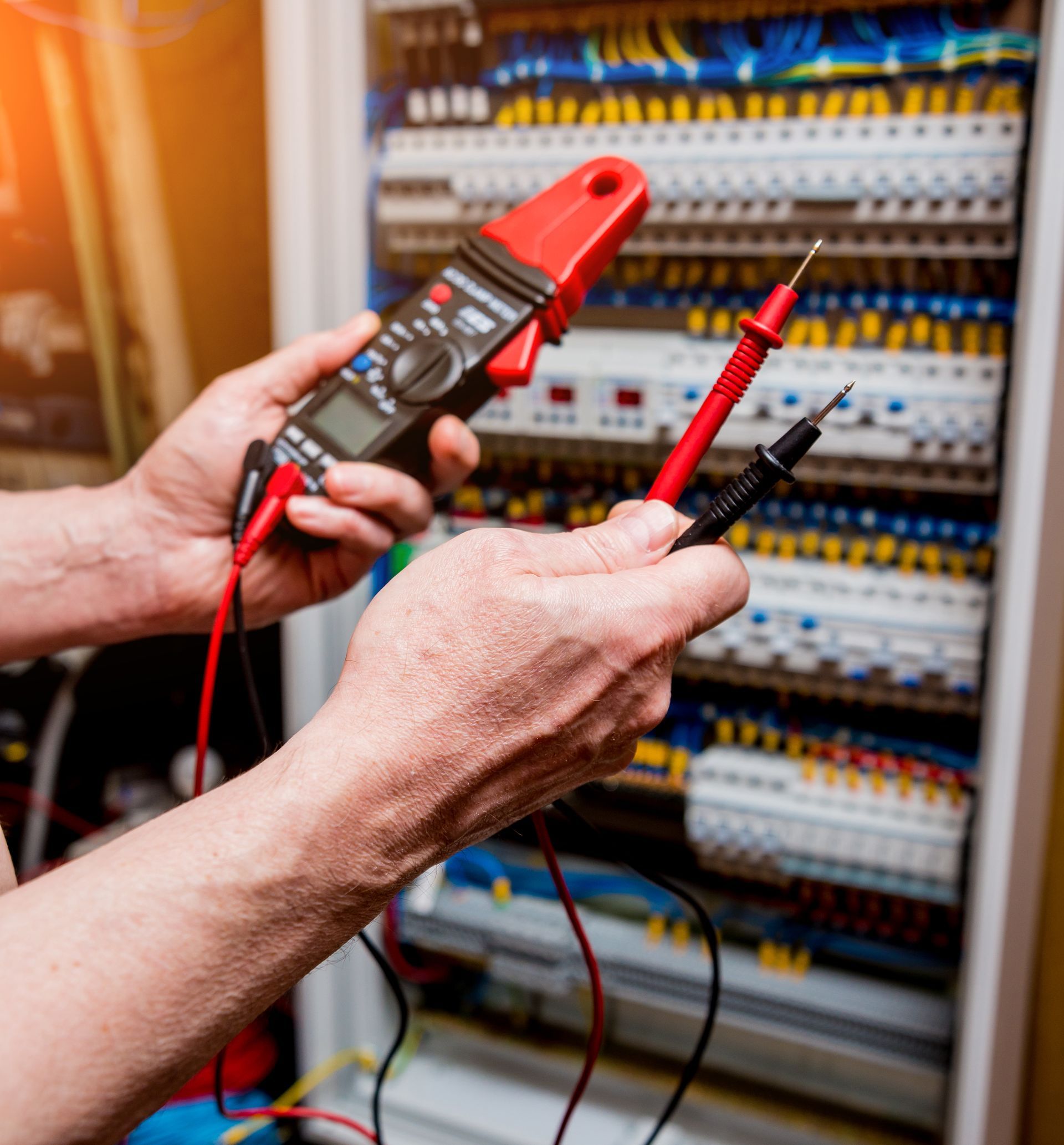
Summer storms, aging gear, and construction activity raise the odds of electrical incidents across Chicagoland. Facility and property managers need a fast, repeatable triage process that protects people, stabilizes the site, and routes the right help without delay. Use this field guide to decide if you are in an electrical emergency, perform immediate make-safe steps, document what matters, and dispatch the correct responders in the correct order. Keep it handy during outages, water events, and repeated trips. What qualifies as an electrical emergency An electrical emergency exists when there is active hazard, credible fire risk, or critical operations impact. Treat the following as emergencies and escalate now: Arcing or sparking at gear, conductors, or terminations Burning odor, melting plastic smell, or visible smoke from panels, transformers, switchgear, receptacles, or lighting Water intrusion near energized equipment, including roof leaks, stormwater, sprinkler discharge, or condensation on enclosures Persistent main breaker trips or feeder trips that will not hold after a single safe reset, especially if life-safety or critical loads are affected Heat at panels or equipment that is hot to the touch, discoloration, or audible buzzing that is new or worsening Life-safety impact such as failed emergency egress lighting, fire pump feeds, medical or critical process loads Utility service issues with downed lines, damaged service mast, pulled meter, or utility-side arcing If in doubt, treat it as an emergency. An electrical fault can be an emergency when it presents fire risk, shock risk, or stops life-safety or mission-critical systems. Immediate make-safe actions Protect people first, then equipment. Do not open energized gear. Do not perform unqualified repairs. Clear occupants from the hazard area. Establish a no-entry perimeter. Keep water away from energized equipment. Do not step in pooled water near electrical gear. If fire is present, pull the fire alarm and call 911. Use only a Class C-rated extinguisher if trained and safe to do so. If a single clearly identified branch circuit is faulting and you can safely isolate it at a labeled breaker without opening panels, do so. Do not force a breaker to hold. Do not reset a main breaker more than once. Repeated trips indicate a fault that requires diagnostics. If a roof or plumbing leak is active above gear, stop the water source if it is safe. Do not remove panel covers. Maintain power to life-safety systems unless a qualified person determines shutoff is safer. Prioritize egress lighting and fire alarm. Who to call, in what order Use this call path to avoid delays and misroutes. Life safety threat, smoke, or fire: Call 911. Downed lines, service drop damage, or utility-side arcing: Call the utility. In Chicago and most suburbs that is ComEd outage reporting. Keep people clear until utility makes safe. Building-side hazard, arcing in panels, water near energized gear, repeated main trips, or critical load failure: Call a licensed commercial emergency electrician with 24/7 response. TCL Electrical & Lighting operates a 24/7 Emergency Response Team across the greater Chicago area. For rapid dispatch, call 630.844.3274. For regional entry points and planned work in the western suburbs, see the Naperville commercial electricians page and the Batavia 24/7 emergency electricians pathway for immediate help. Naperville area commercial response and scheduling: see the page for a 24/7 electrician in Naperville Batavia area urgent response, including lighting-related emergencies: see 24/7 emergency lighting repairs in Batavia Triage decision tree Follow this simple workflow. See, hear, or smell hazard? Yes, go to A. No, go to B. A) Active hazard present: Fire, heavy smoke, or downed lines: Call 911, then utility if lines are down, then 24/7 electrician. Arcing, burning odor, water near gear, main will not hold: Evacuate area, isolate only if safe, call 24/7 electrician. Life-safety systems affected: Maintain egress, post fire watch if required by policy, call 24/7 electrician. B) No active hazard, but repeated trips or hotspots: If a single branch trips once, document and schedule service. If the same breaker trips again or a feeder/main trips, escalate to emergency response. Documentation standards during an incident Accurate records speed diagnostics and reduce downtime. Capture: Time, weather, and what triggered the event Exact equipment IDs (panel names, breaker numbers, location tags) What was running on the affected circuits (HVAC, pumps, IT, lighting) Photos of indicators and labels only, not inside energized gear Odors, sounds, visible arcing, discoloration, or moisture paths Actions taken (who, what, when), including resets attempted Store notes with your panel schedules and single-line diagrams for follow-up service and compliance review. When to escalate to 24/7 response Escalate immediately if any of the following are true: Two or more warning signs appear together, such as odor plus heat, or moisture plus tripping Main or feeder trips recur after a single safe reset Any condition threatens people, security, or business-critical operations Water is present near energized equipment Life-safety systems are impaired If the issue is isolated to a noncritical branch circuit that trips once and holds after a single reset, capture details and schedule maintenance within 24 to 72 hours. After the incident: stabilize and prevent recurrence Once the site is made safe and temporary power is in place as needed, close the loop: Root-cause diagnostics and corrective repairs Thermal scan and torque check for nearby terminations Update labeling, panel schedules, and single-line diagrams Add moisture controls where leaks occurred Enroll affected gear in preventive maintenance TCL provides Electrical Maintenance programs that reduce nuisance trips and fire risk, and Project Consultation to plan compliant remediation. For facilities planning energy-first upgrades after an outage, see our guidance on design-build electrical in North Aurora for coordinated repairs and retrofit planning. Printable checklist Use this one-page sequence during events. Check for hazard: arcing, odor, smoke, water, heat, downed lines, or life-safety impact. Protect people: clear area, control access, avoid water near gear. Call path: 911 for fire, utility for downed lines, 24/7 commercial electrician for building-side hazards. Isolate if safe: one labeled breaker only, no panel covers, no forced resets. Preserve life safety: keep egress lit, start a fire watch if policy requires. Document: time, weather, equipment IDs, loads, observations, photos, actions. Handoff: brief the arriving electrician with notes and photos. Preventive follow-up: schedule diagnostics, repairs, testing, and maintenance. FAQ What counts as an electrical emergency? Events with arcing, smoke, burning odor, water near energized gear, repeated main or feeder trips, or any impact to life-safety or critical operations. Is an electrical fault an emergency? Yes when it presents fire or shock risk, trips main or feeder protection, or disables critical loads. When should I call an emergency electrician? Immediately for arcing, burning odor, smoke, water near gear, or any trip that will not hold after one safe reset. Who should I call if there is no electricity? If the outage appears utility-side or widespread, call the utility first. If building-side or localized to your facility, call a 24/7 commercial electrician. What should I do first in an electrical emergency? Protect people, keep clear of energized equipment and water, call 911 if there is fire, then dispatch a qualified 24/7 electrician. Summary and next step Electrical triage is about speed, order, and documentation. Confirm hazard, protect people, call the right party, isolate only if safe, and record what you see. For 24/7 Emergency Response and Rapid Restoration in Chicagoland, call 630.844.3274. For planned remediation and prevention, schedule Electrical Maintenance or request Project Consultation. For regional access in the western suburbs, you can start on the Naperville commercial electricians page or the Batavia 24/7 emergency electricians page for immediate routing.
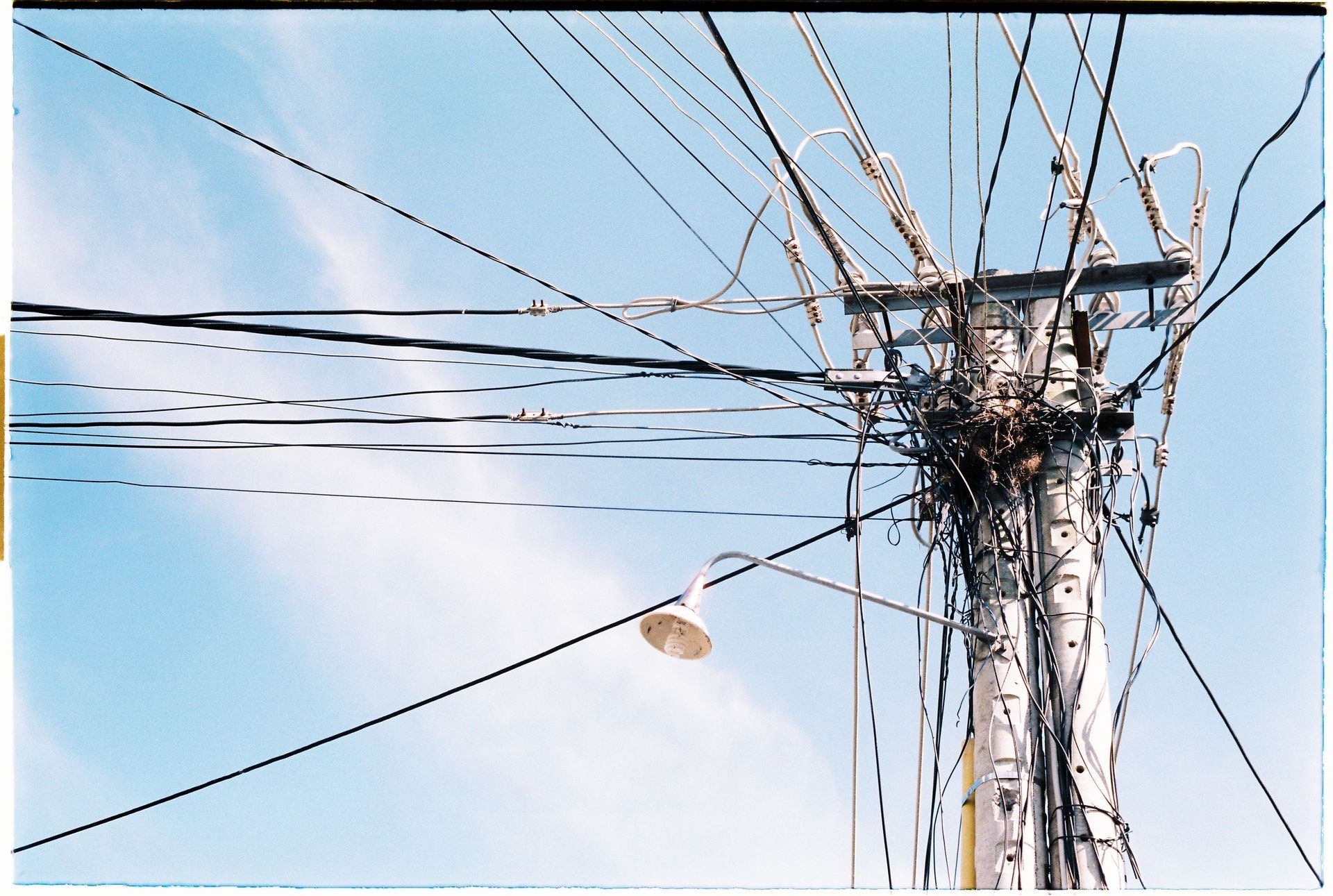
The right electrical partner can make a summer project straightforward and safe. The wrong fit can add delays, change orders, and risk. If you manage commercial or industrial work across Chicagoland, the best time to de-risk is before you issue the RFP. This guide clarifies who you need, how to qualify them in Illinois, and what to ask so proposals are complete, comparable, and aligned to your schedule. It also outlines how to negotiate scope and value, not just hourly rates. TCL Electrical & Lighting supports commercial and industrial facilities across Cook, DuPage, Kane, Lake, and Will Counties with more than 30 technicians, 20-plus years of experience, and a 24/7 Emergency Response Team. Use the checklists below to standardize your vendor selection, then send your scope for a free consult and schedule alignment. Electrician vs. electrical contractor vs. industrial electrical contractor Electrician: A licensed tradesperson who performs hands-on installation, troubleshooting, and repair. Electricians typically work under the supervision and licensing umbrella of a contractor on larger projects. Electrical contractor: A licensed business entity that employs electricians and manages projects. Contractors carry insurance, pull permits, coordinate with inspectors and other trades, provide project management, and warranty their work. Industrial electrical contractor: A contractor specialized in industrial environments, such as plants and distribution centers. This team is geared for higher voltages, complex power distribution, motor controls, PLC and controls integration, confined spaces, and lockout/tagout-heavy workflows. Documentation, shutdown coordination, and safety programs are typically more rigorous. When to choose each: Small repairs, limited circuits, simple device swaps: an electrician dispatched by a contractor or service department. Tenant improvements, panel upgrades, lighting retrofits, multi-trade coordination: an electrical contractor. Process-critical sites, production lines, MCC and VFD integration, medium-voltage interfaces, or extensive shutdown planning: an industrial electrical contractor. Illinois licensing, insurance, and safety you should verify Illinois licensing is issued at the municipal level rather than statewide. Electricians performing work in most Chicagoland jurisdictions must be licensed locally, and permits are commonly pulled by the licensed electrical contractor. Always verify: Current local or municipal contractor license where the project sits Proof of insurance: general liability and workers’ compensation, with policy limits appropriate to project risk OSHA training credentials and documented safety program aligned to NFPA 70E Lockout/tagout procedures and energized work permits when applicable Drug and background screening policies if required by your facility Answering a common question: yes, electricians need to be licensed in Illinois for the jurisdictions that require it, and most Chicagoland municipalities do. Confirm the license in the city or village of the job, and ensure your contractor can pull the required permits. What “good” project management and documentation look like You should expect: A scoping call and site walk that produce a written scope, assumptions, exclusions, and drawings where applicable Single-line diagrams and panel schedules for power work Photometric layouts for lighting changes that affect egress, uniformity, or code compliance Submittals for fixtures, gear, and controls, with cut sheets and spec compliance A detailed schedule, crew plan, and phasing that align with operations or shutdown windows Daily reports, change-order logs, and closeout documents (as-builts, O&M manuals, warranty information) TCL’s planned-project process includes a site walk, custom quote, schedule alignment, and options for phasing and maintenance. RFP structure: how to get comparable proposals To avoid scope gaps and change-order surprises, standardize your RFP: Define objectives, success criteria, and constraints (hours, noise, access, hot work limits) Provide current drawings, panel schedules, and known site conditions Specify required submittals, code references, photometrics (if lighting), and commissioning steps Call out temporary power needs, shutdown windows, and outage backout plans Require unit rates for adds/credits and a change-order approval process Request a baseline schedule with key milestones and crew counts When proposals arrive, compare them against the same headings: scope, assumptions, inclusions, exclusions, schedule, staffing, commissioning, documentation, and closeout. Weigh value-adds such as energy audits, rebate handling, and preventive maintenance options. Pricing clarity: rates, not just numbers How much should an electrical contractor charge per hour? Rates in Chicagoland vary by scope, risk, response time, and union jurisdiction. Hourly ranges for commercial service work can vary widely. Emergency response, off-hours work, and industrial hazards typically price higher than planned daytime work. Instead of fixating on a single rate, ask for: Composite labor rates by role (electrician, foreman, PM) Overtime and emergency multipliers Material handling or markups Equipment rates (lifts, temporary power) Travel and mobilization rules How do you negotiate electrician fees? Shift the conversation to scope and outcomes: Lock in a not-to-exceed for investigative work with a defined deliverable Convert T&M to fixed price after diagnostics clarify conditions Use alternates for materials and methods that yield equal performance Bundle preventive maintenance with installations to reduce callouts Phase non-critical work to fit budget cycles without paying premium rates TCL provides custom, project-based pricing, with free estimates for planned work and emergency pricing upon request. Schedule evaluation and change-order handling Schedule is often the highest cost driver. Evaluate: Realistic crew size and overlap with other trades Procurement lead times for gear and fixtures Access constraints, lift paths, permits, and inspection windows Commissioning duration for controls and life-safety Agree on a change-order protocol before kickoff: Require written CO requests that include cause, scope delta, time impact, and cost Define who approves, at what threshold, and expected turnaround time Keep a live CO log reviewed at each progress meeting Safety programs and emergency response expectations A credible contractor will show: A written safety plan, task hazard analyses, and tailboard talks NFPA 70E practices, PPE matrices, and energized work procedures Lockout/tagout documentation and permit coordination Incident reporting and corrective action workflows What falls under emergency services? Typical triggers include arcing, burning odors, visible smoke, water intrusion near energized equipment, persistent main trips, life-safety lighting failures, and outages affecting critical loads. TCL’s 24/7 Emergency Response Team dispatches to make the site safe, stabilize power, provide temporary power when needed, perform root-cause diagnostics, and plan remediation. If you operate near Naperville and need rapid commercial help, you can review regional capabilities for naperville electrical contractors and emergency coverage on our Naperville service page. For Batavia facilities planning lighting upgrades, see options for commercial lighting installs in Batavia. Explore Naperville commercial capabilities and emergency coverage: your Naperville electrician Review Batavia lighting retrofit options: commercial lighting installs Batavia Value beyond install: maintenance, audits, and phased upgrades Do not leave lifetime cost on the table. Ask for: Preventive maintenance programs with thermal scans, torque checks, and prioritized repairs Free on-site energy audits with ROI modeling and rebate support Lighting controls commissioning and training Phased retrofit planning to minimize downtime and align to budgeting Inventory strategies for critical spares to reduce outage time These add predictable performance and lower risk over the asset life, often more than offsetting modest rate differences. Quick FAQ What is the difference between an electrician and an electrical contractor? An electrician performs the work; an electrical contractor is the licensed company that manages projects, carries insurance, pulls permits, and provides crews and oversight. Industrial electrical contractors specialize in higher-complexity, plant and process environments. How much should an electrical contractor charge per hour? It varies by scope, timing, and risk. Expect higher rates for emergency or industrial work than planned daytime service. Ask for composite rates, multipliers, and markups in writing so comparisons are fair. Do electricians need to be licensed in IL? Yes, in most Chicagoland municipalities. Licensing is handled locally. Verify the contractor’s local license and their ability to pull permits for your job location. How do I negotiate electrician fees? Clarify scope, convert unknowns to investigative allowances, use alternates where performance is equal, request fixed pricing after diagnostics, and bundle maintenance or phased work to reduce premiums. What falls under emergency services? Arcing, burning smells, smoke, water near energized gear, persistent main trips, critical or life-safety lighting failures, and outages that threaten people or operations. Summary and next step Selecting the right partner starts with clarity: match contractor type to the environment, verify local licensing and insurance, require a documented safety program, and demand clear scope, schedule, and change-order controls. Structure your RFP so proposals are directly comparable, then negotiate value through scope, phasing, maintenance, and audits rather than chasing a single hourly rate. TCL Electrical & Lighting brings 20-plus years of commercial and industrial experience, more than 30 technicians, and a 24/7 Emergency Response Team serving Cook, DuPage, Kane, Lake, and Will Counties. Send your scope for a free consult and schedule alignment. We will scope the work, propose options, and help you deliver safely and on time.
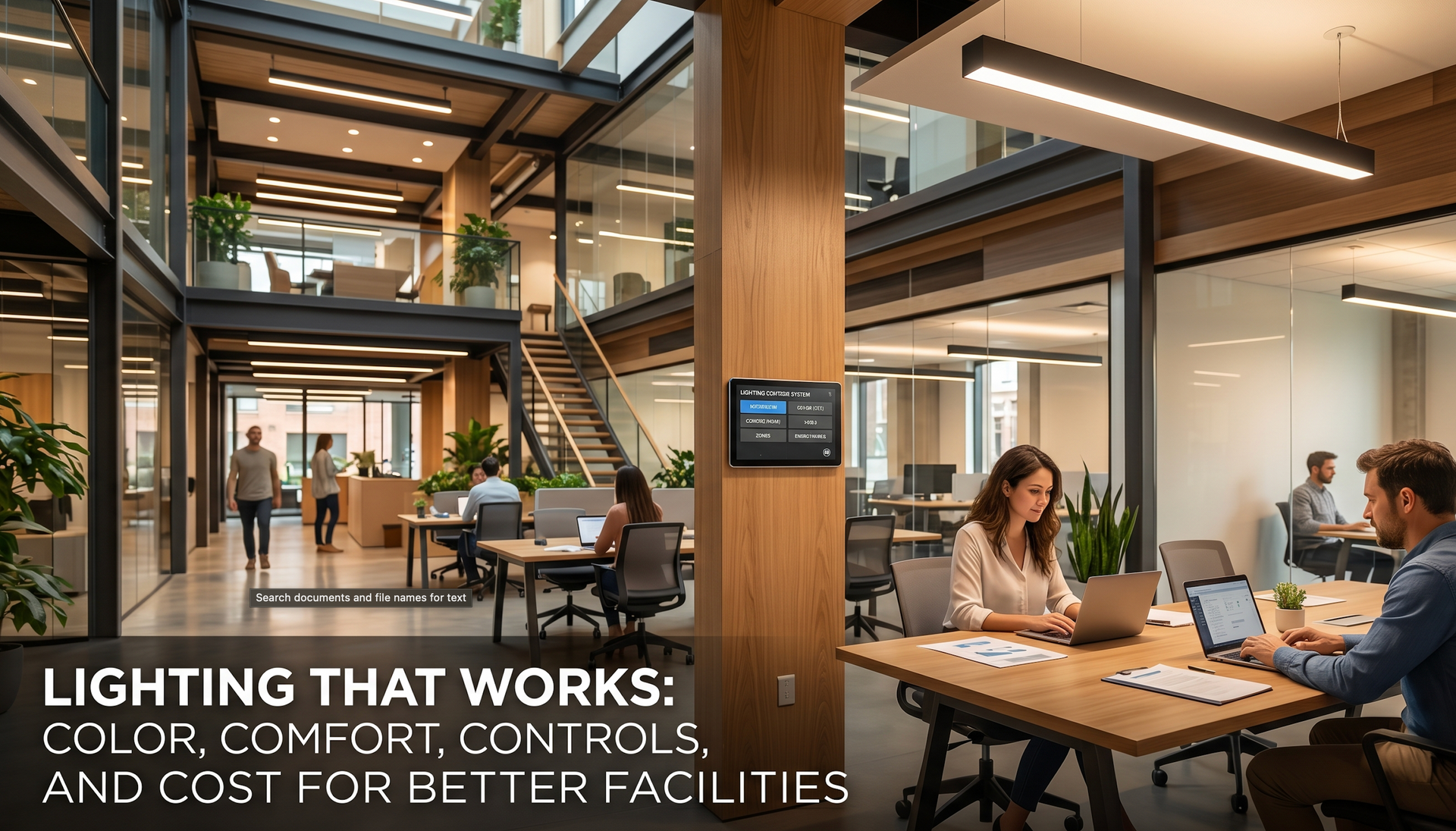
Good lighting is not about wattage alone. It is about giving people the right visibility with the least energy and the least distraction. When lighting is tuned to your tasks and space, occupants work better, feel safer, and your utility bill goes down. This guide breaks lighting into practical pieces so non-engineers can make confident decisions. You will see how the four types of lighting build a complete system, why the four C’s matter, how to choose color temperature by application, and what to watch during a retrofit so you do not trade one problem for another. If you manage offices, warehouses, clinics, or public spaces, use this as a checklist to align design intent with code, controls, and long-term maintenance. The four types of lighting most facilities need A complete lighting plan layers four functions so people always have the light they need, where they need it. Ambient lighting: The general, uniform light that lets you navigate a space. In offices this is usually troffers or panels. In warehouses it is high bays. Think base visibility. Task lighting: Focused light for a specific activity. Examples include under-cabinet lights at workstations, surgical task lights in healthcare, or supplemental lights over packing benches. Accent lighting: Targeted light to draw attention, shape perception, or support wayfinding. Wall washers on displays, uplights on signage, or highlights for architectural features. Emergency and egress lighting: Code-required illumination and exit signs that stay on or come on during power loss. This layer protects life safety and is tested on a schedule. Plan all four layers together. If ambient is supplying too much light to compensate for missing task lighting, energy use climbs and glare increases. The four C’s translated into outcomes The four C’s are a simple framework that connects technical choices to real results: productivity, safety, energy, and satisfaction. Color: Two measures drive how people see. Color temperature (in Kelvin, K) is the visual “warmth” or “coolness” of light. Color rendering index (CRI) indicates how accurately colors appear versus a reference. Offices typically favor 3500K to 4000K with CRI 80 to 90 for balanced comfort and clarity. Healthcare exam areas often use 4000K to 5000K with high CRI for skin tone accuracy. Industrial inspection lines may require high CRI so defects are visible. Comfort: Glare control, uniformity, and flicker management reduce eye strain and headaches. Optics, diffusers, shielding, and correct aiming matter more than raw lumens. Comfort also means quiet drivers and controls that dim smoothly. Controls: Occupancy sensors, daylight harvesting, time scheduling, and task tuning cut wasted run hours. Good controls also stabilize light levels and extend fixture life. Controls should be planned with zones that match how people use the space. Cost: Look beyond unit price. Consider lifecycle cost, energy, maintenance, downtime risk, and available rebates. A well-designed LED and controls package often pays back through energy savings and reduced service calls while improving visibility. 4000K vs. 5000 to 6500K, and where they fit Color temperature choice should follow the work being done, surface reflectance, and daylight availability. Offices and classrooms: 3500K to 4000K supports long-duration comfort and accurate reading on screens and paper. It reduces harsh contrast and perceived glare. 4000K strikes a neutral balance that suits most open offices and conference rooms. Warehouses and production floors: 4000K to 5000K improves contrast for reading labels at height and differentiating materials. Where skylights or clerestories bring strong daylight, 5000K can align perceived color with daylight. Pair with precise optics to keep light on aisles and work zones. Healthcare: Patient rooms often use 3500K to 4000K for comfort and recovery, with tunable options for night mode. Exam and treatment areas benefit from 4000K to 5000K and high CRI so clinicians can see detail and true color. Surgical settings may use higher CCT with very high CRI to improve tissue differentiation. Which is “brighter,” 4000K or 6500K? Brightness is measured in lumens at the source and illuminance (lux or footcandles) on the task. CCT does not directly change lumen output, but higher CCT can be perceived as crisper, which some interpret as brighter. If you need more visibility, adjust lumens and optics to get target footcandles on the work plane, then choose CCT for comfort and accuracy. CRI and visual accuracy Color rendering index (CRI) is a 0 to 100 scale. Higher numbers mean colors look closer to how they appear under a reference source. For most commercial work, CRI 80 is adequate. For retail, healthcare, art, and inspection, CRI 90 can improve recognition of subtle differences. Remember that optical design, reflectance, and cleanliness also influence what people see. Controls that save energy without annoying people Poorly tuned controls cause complaints. Good controls are almost invisible to occupants. Occupancy and vacancy sensing: Use vacancy mode in private offices so lights only turn on when manually requested, and off when empty. In large open areas, occupancy sensors with time delays reduce false offs. Daylight harvesting : Photosensors trim output near windows to maintain a consistent target level. Calibrate per zone and keep sensors away from drafts or reflective glare. Task tuning and scheduling: Set maximum output per zone to match the task and cap over-lighting. Use schedules for common areas and exterior lighting, with overrides for after-hours use. Plan sensor placement during design, not after installation. Commissioning is not optional. It is the step that makes the system work as intended. Glare, optics, and visual comfort Glare is lost time and complaints. Control it by selecting the right optics and applying light only where needed. Offices: Use diffusers or microprismatic lenses, maintain luminance limits within view angles, and coordinate light levels with monitor placement. Warehouses: Use narrow or aisle optics to put light on the floor and racking faces, not into eyes when operators look up. Healthcare: Shield sources in patient rooms to reduce direct view, and provide layered lighting for staff tasks without disturbing patients. Photometric layouts validate that fixtures, optics, and spacing meet target footcandles and uniformity. This is where many retrofits fail when they swap one fixture for another without checking distribution. Retrofit pitfalls and how TCL designs around them Common issues in lighting retrofits are predictable and avoidable with planning. Mismatched optics: A panel may replace a parabolic troffer but produce more high-angle brightness and glare. Solution: run a quick photometric check and choose optics that match the task and ceiling height. Poor controls integration: New LED fixtures can flicker or fail to dim with legacy dimmers. Solution: verify driver compatibility, select a controls platform early, and commission zones after installation. Code and labeling gaps: Ballast-bypass (Type B) work without relabeling creates hazards. Solution: follow lockout/tagout, use listed components, apply required labels, and update single-line diagrams. Missed rebate eligibility: Some utilities require DesignLights Consortium (DLC) listings or specific control strategies. Solution: align product submittals with incentive rules before ordering. Over- or under-lighting: One-for-one swaps can swing levels 30 percent or more. Solution: adjust lumen packages and spacing to meet target footcandles, not just fixture count. TCL Electrical & Lighting scopes retrofits with an energy-first and safety-first process: on-site audits, photometrics, color and CRI selection by application, controls design with commissioning, and documented code compliance. For regional support in and around Naperville, you can start with an audit through our page for lighting design and install in Naperville to plan an energy-efficient retrofit that is controls-ready. Application snapshots Open office: 4000K panels or troffers with UGR-conscious optics, CRI 80 to 90, vacancy sensors in enclosed rooms, daylight zones at the perimeter, task lights at focus areas. Target comfortable reading levels on desks, not maximum brightness everywhere. High-bay warehouse: 4000K to 5000K high bays with aisle optics, high mounting height lumen packages, occupancy sensors by aisle, and daylight harvesting under skylights. Aim for uniform vertical illuminance on racking faces for pick accuracy. Clinic and patient areas: 3500K to 4000K ambient with high CRI task lighting at exam zones, dimmable night settings, and dedicated egress coverage. Controls sequences should prioritize patient comfort and staff visibility. If you need localized commercial support, our Naperville commercial electricians can align fixture choices, controls, and code needs with your operating schedule. Quick FAQ What are the four types of lighting? Ambient, task, accent, and emergency/egress. What are the four C’s of lighting? Color, comfort, controls, and cost. Together they link visual quality and energy to outcomes like productivity and safety. Which is brighter, 4000K or 6500K? Neither by CCT alone. Brightness is lumens and illuminance on the task. Higher CCT can feel crisper, but verify footcandles and choose CCT for comfort and accuracy. What is the best type of lighting for a house? Residential spaces usually favor warm to neutral white (2700K to 3000K for living spaces, 3000K to 3500K for kitchens and baths) with good glare control and dimming. For this article’s audience, apply the same principle in amenity areas or model units, but tune for the task and occupant comfort. What are the disadvantages of retrofitting? Risks include mismatched optics and glare, controls incompatibility, code and labeling issues with ballast-bypass work, missed rebates, and over- or under-lighting. A structured audit and design process prevents most of these. How to start with TCL A short site walk and energy audit will identify the right CCT, CRI, optics, and controls for each space, plus your rebate path and phased schedule. If you manage facilities near Naperville and need help planning energy-efficient lighting installation in Naperville with controls integration and commissioning, our team can help. For plants and campuses in Batavia, explore high-efficiency fixtures in Batavia to convert legacy systems to LED with proper labeling and code compliance. Summary and next step Effective lighting is layered, comfortable, controllable, and cost-aware. Choose CCT and CRI by task, control glare with the right optics, and let smart controls cut waste without disrupting people. Avoid retrofit pitfalls by validating optics, documenting wiring changes, integrating compatible controls, and aligning with incentives. Request a lighting assessment with a controls-ready retrofit plan. TCL Electrical & Lighting will model light levels, recommend optics and color, specify compatible controls, and map a phased path to energy savings with clear compliance and commissioning.
Spring maintenance windows are the best time to reset electrical safety. Loads shift with seasonal operations, moisture returns, and panels that ran hot over winter may be at their limits. Small warning signs show up before serious failures and fires. Catch them now and you avoid downtime later. This guide outlines clear indicators of electrical risk, a quarterly inspection checklist aligned to NFPA and OSHA expectations, immediate make-safe steps for facilities teams, and how a structured preventive electrical maintenance program reduces unplanned outages and fire risk. TCL Electrical & Lighting supports commercial, industrial, healthcare, and municipal facilities across the greater Chicago area with planned maintenance and 24/7 emergency response. Use this as a practical field reference during your spring walk-throughs. Early warning signs that precede electrical fires Electrical fires rarely start without signals. Document and escalate any of the following: Overheating panels or gear: Panel fronts too hot to touch, paint discoloration, melted labeling, or a heat haze on thermal scans typically indicate loose terminations, overloaded circuits, or failing breakers. Recurring breaker trips: Repeated trips on the same circuit point to overload, a fault, or deteriorated insulation. Do not hold breakers closed or upsize them to mask the symptom. Buzzing, crackling, or arcing: Audible noise from panels, disconnects, or fixtures suggests loose connections or failing components. Arcing is an immediate hazard. Burnt odor or discoloration: A metallic, fishy, or burnt-plastic smell near panels, receptacles, or fixtures is a red flag. Look for soot at vents or device edges. Warm receptacles and plugs: Outlets or device cords that are warm under normal load indicate poor contact or overcurrent. Moisture near energized equipment: Condensation on gear, roof or wall leaks, or standing water near panels, MCCs, or transformers increases shock and fire risk. Damaged cords and devices: Cracked jackets, exposed conductors, broken strain reliefs, and taped splices should be removed from service. Overloaded power distribution: Daisy-chained power strips, multi-outlet cubes, and cords under rugs or on cable reels under load concentrate heat and create trip hazards. If two or more of these appear together, escalate to a make-safe action and call for a licensed commercial electrician. What qualifies as an electrical emergency Treat the following as emergency conditions that require immediate isolation and professional response: Active arcing, smoke, burning odor, or visible fire at any electrical device or panel Water intrusion contacting energized gear or conductors Repeated main breaker trips or loss of power to life-safety systems Exposed live parts, energized equipment with damaged enclosures, or missing dead fronts Equipment that shocks personnel or tingles on contact Any incident involving suspected arc flash, arc blast, or energized work injury In any emergency, protect people first, then isolate energy sources only if it can be done without risk. Do not open gear you are not qualified to service. A quarterly inspection checklist for facilities Use this checklist as part of your spring maintenance program. It aligns with common practices derived from NFPA 70E (electrical safety in the workplace) and OSHA general industry control of hazardous energy. Site-specific procedures and labeling should take precedence. Panels and switchgear Verify clear working space and labeling. Remove stored items from dedicated electrical rooms. Inspect for heat, discoloration, corrosion, or missing screws and dead fronts. Listen for buzzing. Note any warm breakers or hot spots for thermography. Confirm panel schedules match actual loads. Power distribution and feeders Check cable trays and conduits for damage, strain, or unsupported runs. Inspect transformers for leaks, blocked ventilation, or unusual noise. Confirm grounding and bonding conductors are intact and labeled. Receptacles, cords, and point-of-use devices Remove damaged cords and non-listed adapters from service. Test GFCI and AFCI devices per manufacturer instructions. Eliminate daisy chains and replace with properly rated circuits. Motors, controls, and equipment connections Verify strain relief at terminations. Look for heat at starters or VFDs. Check for dust buildup in enclosures that can trap heat. Confirm emergency stops and interlocks function. Lighting and life-safety systems Test emergency and exit lighting. Replace failed lamps and batteries. Confirm egress pathways are illuminated to required levels. Inspect exterior fixtures and photocells for damage and water ingress. Environment and housekeeping Control moisture sources and dehumidify electrical rooms as needed. Maintain temperature and ventilation clearances at equipment. Keep floors dry and remove conductive debris. Document findings with photos, panel IDs, breaker numbers, and load conditions. Prioritize corrective actions by risk to people and operations. Immediate risk reduction before professionals arrive When you identify a hazard, take conservative, low-risk steps while waiting for a licensed team: De-energize affected circuits if the disconnect is accessible and safe to operate. Lockout and tagout per your written program. Keep personnel clear of the area. Post temporary signage or barricades. Remove portable loads from suspect circuits to reduce heating. Isolate water sources. Place drip protection above gear only if it does not obstruct ventilation and is allowed by your AHJ. Ventilate spaces with odor or light smoke if safe to do so. Do not open energized enclosures, tighten lugs, or attempt repairs without qualified personnel and arc-flash PPE. If you need rapid on-site support or temporary power to maintain critical loads, contact a 24/7 commercial team. TCL’s Emergency Response Team can dispatch, perform make-safe actions, and provide temporary distribution while root-cause diagnostics proceed. How preventive electrical maintenance cuts fires and downtime A structured preventive program targets the failure modes that lead to fires and outages: Torque and termination checks catch loosened connections that drive heat. Infrared thermography identifies hidden hotspots under normal load. Load studies and panel schedule updates correct chronic overloads. Cleaning and contact inspections reduce carbon tracking and arcing. Environmental controls minimize condensation and corrosion. Documented testing of GFCI, AFCI, and life-safety circuits keeps protection active. TCL Electrical & Lighting offers customizable maintenance plans that combine inspections, thermal scans, prioritized repairs, and follow-up verification. The result is fewer unplanned trips, lower fire risk, and better compliance posture. If you manage sites around Naperville, you can schedule support with licensed commercial electricians locally. For example, facility teams often start with a focused safety audit or a maintenance walkthrough with Naperville commercial electricians . If your campus is in Batavia or nearby, urgent needs can be routed to the Emergency Response Team via the regional page for Batavia 24/7 emergency electricians . NFPA and OSHA-aligned practices to standardize Maintain an electrical safety program that defines qualified persons, energized work permits, arc-flash boundaries, and PPE categories per NFPA 70E. Train authorized employees and keep records. Apply lockout/tagout per OSHA 1910.147 when servicing. Verify absence of voltage before work begins. Label equipment with available incident energy or PPE category based on an arc-flash study, and keep single-line diagrams current. Keep required working clearances and dedicated space around equipment per the National Electrical Code. Do not use electrical rooms for storage. Use listed equipment and components only, and match overcurrent devices to conductor ampacity and equipment ratings. These practices reduce human error, which is a major contributor to electrical incidents. FAQ: fast answers for safety leaders What are the early warning signs of an electrical fire? Overheating panels, repeated breaker trips, buzzing or arcing sounds, burnt odors or discoloration, warm outlets, moisture near gear, damaged cords, and overloaded power strips. What is considered an electrical emergency? Any arcing, smoke, burning odor, water contacting energized gear, repeated main trips, exposed live parts, shock incidents, or failures affecting life-safety systems. What is the number one killer of electricians? Electric shock from contact with energized parts is the leading cause of fatal incidents. Arc flash and arc blast also cause severe injuries and fatalities. What should I do in an electrical emergency? Evacuate or clear the area, call emergency services if there is fire or injury, de-energize only if it is safe and you are trained, apply lockout/tagout, and call a qualified emergency electrician. When should I call an emergency electrician? Immediately when you detect arcing, burning odor, smoke, shocks, water on or near gear, repeated main trips, or loss of life-safety systems. If you need a same-day assessment across the greater Chicago region, including North Aurora, TCL can coordinate north aurora emergency electrical maintenance as part of a structured dispatch process. Next steps Use this checklist during your spring inspection cycle. Log every finding, assign risk levels, and schedule corrective work. For recurring hotspots, nuisance trips, or moisture exposure, move directly to a professional assessment. TCL Electrical & Lighting offers preventive electrical maintenance programs, safety audits, and 24/7 emergency response to help you reduce fire risk, cut downtime, and stay compliant. Schedule a preventive maintenance walkthrough or safety audit and set your facility up for a safer quarter.

Upgrading from fluorescent to LED can cut lighting energy by 30 to 60 percent, reduce maintenance visits, and improve visual comfort. The challenge is choosing a retrofit path that is safe, code compliant, and cost effective for your mix of fixtures and operating hours. This guide breaks down the four main approaches, where each fits, and the safety steps that matter. You will also see how photometrics, controls, and utility incentives affect total ROI. A short decision tree and two mini scenarios translate the options into clear next steps. If you manage offices, warehouses, healthcare spaces, or municipal sites in the greater Chicago area, this gives you a practical framework to plan a clean, low-risk conversion. The four retrofit pathways There are four standard routes to convert fluorescent fixtures to LED. Each has tradeoffs in labor, safety, controls, and long-term maintenance. Type A - ballast compatible LED tubes What it is: Plug-in LED tubes that operate on specific fluorescent ballasts. Pros: Fastest swap, minimal labor, lowest disruption. Cons: Ballast stays in the circuit, so you keep a failure point and some standby power draw. Not all ballasts are compatible. Light output and dimming depend on ballast behavior. Type B - ballast-bypass LED tubes (direct-wire) What it is: The ballast is removed or bypassed. Line voltage is wired directly to the lamp holders per the tube manufacturer’s wiring diagram (single-ended or double-ended). Pros: Higher efficiency than Type A, ballast maintenance eliminated. Cons: Requires safe lockout/tagout and rewiring by qualified personnel. Miswiring can create shock hazards. Future service must be clearly labeled. Type C - external LED driver with LED tubes What it is: The fluorescent ballast is replaced with an LED driver matched to the tubes. The tubes are low voltage and rely on the driver, similar to an LED fixture. Pros: Best for dimming and controls integration, stable performance, longer system life. Cons: Higher material cost and more labor than Type A or B. Requires space for driver and clear labeling. Full fixture replacement (LED troffer, strip, high bay, or wrap) What it is: Remove the legacy fixture and install a new LED fixture or a listed troffer retrofit kit. Pros: Highest efficiency, best optics, clean aesthetic, longest warranty, easiest control integration, and often strongest utility rebates. Cons: Highest upfront cost, but typically best lifecycle value, especially for fixtures in poor condition or with long burn hours. Safety and code considerations that come first Lockout/tagout: De-energize and verify absence of voltage before any ballast removal or rewiring. Wiring changes: Follow the LED lamp or driver manufacturer’s diagram exactly. Use listed lampholders for the intended voltage. Cap and secure unused conductors. Labeling: Apply permanent labels noting that the fixture has been modified and indicating lamp type and wiring method, especially for Type B and Type C. Listings and code: Use UL or ETL listed lamps, drivers, or retrofit kits. Ensure the modified assembly maintains listing where required. Follow NEC, local amendments, and NFPA life-safety requirements for egress and emergency circuits. Photobiological safety and flicker: Select reputable products with low flicker and tested output to protect occupants and meet healthcare or task-lighting expectations. Qualified personnel: Engage licensed electricians for ballast-bypass, driver installs, and fixture replacements. If you need support aligning your scope to code requirements in the Chicago area, schedule a free on-site energy audit with TCL Electrical & Lighting. Our team handles energy-efficient lighting, lighting retrofits, electrical installation, and incentive documentation. Photometrics: getting the light right LED is not a one-to-one swap based on lamp count. Aim for equal or better visibility with fewer watts and better optics. Lumens and distribution: Compare delivered lumens from the luminaire, not just lamp ratings. Many LED troffers and strips deliver more usable light on task planes due to better optics. Color quality: Choose 80+ CRI in most offices and healthcare support spaces; 90 CRI where color rendering is critical. Color temperature: 3500 K to 4000 K is common in offices, 4000 K to 5000 K in warehouses and back-of-house. Glare and UGR: Use lenses and distributions that control glare in offices and healthcare corridors. Controls impact: Occupancy sensing, daylight harvesting, and scheduling lower average light levels while preserving visual quality when occupied. Utility rebates, maintenance savings, and ROI Rebates: ComEd and other regional programs often provide incentives for listed LED tubes, retrofit kits, and new fixtures. Fixture replacements and controls usually qualify for higher incentives than tube swaps. Maintenance savings: Removing ballasts and moving to long-life LED drivers and fixtures reduces lift time and inventory. Many commercial LED fixtures carry 5-year warranties, sometimes more. ROI timelines: Offices with moderate hours might see 2 to 4 year paybacks; warehouses at 2 or 3 shifts can be faster due to long burn hours and stronger fixture-based rebates. Actual timelines depend on current kWh rates, operating hours, and product selection. Decision tree: choose the right path Start with three inputs: fixture condition, operating hours, and control strategy. If fixtures are in poor condition, yellowed lenses, frequent ballast failures, or non-standard sizes: choose full fixture replacement or a listed retrofit kit. If fixtures are in fair condition with 10 to 16 hours per day: Type B or Type C. Type C if you want dimming or networked controls. If fixtures are in good condition and you need a rapid, low-disruption swap with limited controls: Type A, but confirm ballast compatibility and understand the ballast remains a maintenance point. If you plan advanced controls, daylighting, or centralized scheduling: full fixture replacement or Type C for better driver-level control and rebate eligibility. Mini scenarios: Chicago warehouse and office floor Chicago warehouse, 28 ft mounting height, 2-shift operation, existing T8 high bays with aging ballasts Recommendation: Replace with LED high bays with integrated occupancy sensors and high/low dimming. Expect significant kWh reduction and strong utility incentives. Type B at height adds wiring risk and mixed results on optics. A new fixture gives proper beam distribution and easier controls. Downtown office floor, 2x4 troffers, 12 hours per day, acceptable housings but frequent ballast outages Recommendation: Use a listed troffer retrofit kit or a Type C external driver system for uniform lensing and future dimming. If capital is tight and controls are minimal, a clean Type B bypass can work, but label each fixture and standardize wiring. For a local partner on turnkey lighting retrofit in St. Charles or energy-efficient lighting installation in Naperville, TCL can scope options on site and model ROI. Answers to common questions Can you just replace a fluorescent tube with LED Sometimes. Type A lamps are designed to operate on certain fluorescent ballasts. You must verify ballast compatibility on the lamp manufacturer’s list. Without a compatible ballast, choose Type B, Type C, or a full fixture replacement. Do LED tubes need a special ballast Type A lamps need a compatible fluorescent ballast. Type B lamps bypass the ballast and connect to line voltage. Type C systems use a dedicated LED driver instead of a ballast. How do you know if your ballast is compatible with LED Check the LED tube’s specification sheet for supported ballast models. Compare your ballast label to that list. If it is not listed, do not assume compatibility. What happens if you put LED bulbs in a fluorescent fixture If the ballast is compatible and the LED is Type A, the lamp should operate. If not compatible, the lamp may flicker, fail to start, or be damaged. With Type B, the ballast must be removed or bypassed and the fixture re-labeled, or you risk shock hazards and equipment damage. How much does it cost to convert fluorescent to LED Costs vary by method, fixture count, mounting height, controls, and rebates. Type A is typically the lowest labor cost, Type B and Type C are moderate, full fixture replacement is highest upfront but often best lifecycle value. A site audit is needed for a precise quote and payback model. Implementation checklist Confirm scope: inventory fixtures, note conditions, heights, and areas with code-required light levels. Choose path: Type A, B, C, or full fixture replacement by area and objective. Plan controls: occupancy sensors, daylighting, scheduling, or networked control. Validate products: listings, driver compatibility, photometrics, warranties. Schedule work: coordinate lockout/tagout, safe access, labeling, and waste handling for lamps and ballasts. Capture incentives: file pre-approval where required; document final counts and product IDs. When to bring in a pro Ballast-bypass and driver work involve energized conductors and labeling requirements. For multi-site portfolios, a phased plan reduces disruption and aligns with capital budgets. TCL performs free on-site energy audits and produces retrofit plans with projected ROI based on your exact hours, fixture mix, and control strategy. If you manage facilities in the western suburbs, you can learn more about working with an electrician in Naperville IL for commercial lighting or request help from a Batavia electrician for fluorescent to LED conversions. Our team also supports site lighting retrofit in North Aurora with incentive guidance and code compliance. Explore commercial lighting support with a Naperville electrician: https://www.tclelectric.com/commercial-electrician-lighting-naperville-il Plan a fluorescent to LED conversion with a Batavia electrician: https://www.tclelectric.com/led-lighting-conversions-batavia-il Coordinate site lighting retrofit in North Aurora: https://www.tclelectric.com/ Summary and next step Choose the retrofit path that matches your fixture condition, hours, and control goals. Type A is fast but ballast dependent. Type B removes the ballast for better efficiency. Type C enables strong controls and stability. New fixtures deliver the best optics, highest rebates, and longest life. Lockout/tagout, correct wiring, and clear labeling are non-negotiable. Book a free on-site energy audit with TCL Electrical & Lighting. You will receive a tailored retrofit plan, photometric guidance, and a projected ROI with available utility incentives.

Unexpected outages cost time and revenue. Planned upgrades pay you back in lower energy and maintenance costs. Both require clear budgets and dependable execution. This guide explains how commercial and industrial electrical pricing typically works in Chicagoland. It separates emergency response from scheduled projects, outlines the factors that move numbers up or down, and gives you checklists to plan with fewer surprises. TCL Electrical & Lighting provides transparent, custom quotes and free estimates for planned work, with 24/7 emergency support when you need it. Emergency vs. planned work at a glance Emergency work is unplanned, time sensitive, and risk focused. Crews mobilize after hours, triage hazards, stabilize power, and document what is safe to defer. Rates often reflect after-hours labor, rapid dispatch, and risk controls. Planned work is scoped in advance, sequenced around operations, and optimized for lifecycle cost. Estimates are free for planned projects at TCL. Pricing is built from defined labor, materials, permits, and schedule. Both paths follow the same fundamentals: scope, complexity, compliance, and time. The differences come from response speed, access conditions, and risk. What drives cost on commercial and industrial electrical jobs Scope and complexity Defined scope lowers uncertainty. Adders appear when crews must troubleshoot unknown faults, open up concealed spaces, or coordinate with multiple trades. High-complexity tasks, like switchgear diagnostics or selective coordination studies, require senior technicians and more planning time. Voltage class and system type Higher voltage, arc flash risk, or critical systems (hospitals, manufacturing lines, life-safety circuits) require specialized tooling, PPE, and procedures. Expect additional time for lockout/tagout, energized work permits when allowed, and staged shutdowns. Time-of-day and calendar impacts Night, weekend, or holiday dispatch drives premium labor and overtime. In emergencies, after-hours minimums and callout fees are common. In planned work, off-shift scheduling can still be cost effective if it avoids production losses. Safety and compliance requirements NFPA 70E, OSHA, and local authority requirements shape staffing, PPE, barricades, and documentation. Hazard assessments, permits, and inspection coordination add time but reduce incident risk. Materials and availability Stock items are predictable. Special-order gear, long-lead luminaires, or custom bus work affect timelines and carrying costs. Emergency temporary power or rental equipment is another variable. Site access, union rules, and travel Downtown delivery windows, security screening, escorts, or union site rules can extend crew time. Travel across the greater Chicago area is considered in scheduling and mobilization. Permits and inspections Jurisdictional requirements vary by city and county. Permit acquisition and inspection scheduling should be built into the plan. How pricing is structured in practice Hourly labor with minimums: Common for service calls, troubleshooting, and small tasks. An after-hours minimum and a separate callout charge can apply for emergency mobilization. Time and materials: Used when the scope is open-ended. Transparent line items document technician hours, materials, rentals, and permits. Fixed or not-to-exceed quotes: Suitable for defined scopes, like lighting retrofits or panel upgrades, once a site walk confirms conditions. Maintenance agreements: Custom plans with defined inspection intervals, testing, and response priorities to reduce unplanned outages. TCL provides free estimates for planned work and issues clear, custom quotes for defined scopes. Emergency rates are shared upon request and stated before dispatch whenever the situation allows. Typical ranges, without fixed price promises How much do electricians charge for emergency calls: Expect a callout fee plus an elevated hourly rate for after-hours response. The total varies by distance, crew size, and hazard level. What do most electricians charge per hour: Commercial and industrial rates reflect technician certification, union scale where applicable, and system complexity. The rate for a senior technician handling switchgear will differ from a junior performing lighting maintenance. How much should you expect to pay: Budget based on scope elements above. For planned work, a site assessment allows a precise line-item estimate. For emergencies, the first hours cover safety stabilization and diagnostics, then you choose next steps. Do electricians give free quotes: TCL offers free estimates for planned projects and energy audits. Emergency dispatch is typically billable due to the immediate mobilization and risk profile. What does an electrician charge for a callout: Many firms apply a callout or trip charge for urgent mobilization, especially after hours. This is separate from hourly labor and materials. These ranges are directional only. The fastest way to create an accurate budget is to request a tailored estimate after a short scoping call and site walk. Ways to lower lifetime electrical costs Preventive electrical maintenance: Thermal scans, torque checks, breaker testing, and cleaning reduce failures and arc flash risk while extending equipment life. Routine tasks can be scheduled during low-impact windows. Energy-efficient lighting and controls: LED retrofits, networked controls, and daylight harvesting cut energy and maintenance costs. Many projects qualify for utility incentives that improve payback. Phased retrofits: Prioritize high-burn areas, failed or obsolete fixtures, and panels at capacity. Stage upgrades to align with fiscal years and downtime windows. Power quality and load management: Assess harmonics and unbalanced loads to reduce nuisance trips and equipment wear. If lighting upgrades are part of your plan in DuPage County, explore options with a Naperville-focused partner. Learn more about commercial services with a trusted Naperville electrician on the dedicated page for naperville commercial electricians at TCL. Budgeting checklist for procurement and building owners Use this short list during planning and vendor selection. Define goals: uptime, safety, energy savings, or code compliance. Document constraints: shutdown windows, access limits, union or site rules. Provide single-line diagrams, panel schedules, and any prior test reports. Clarify voltage classes and critical loads; flag life-safety circuits. Confirm permit jurisdiction and inspection requirements. Ask for alternates: value engineering options, phased schedules, or temporary power strategies. Request warranty terms and maintenance recommendations. Questions to ask any contractor What is your emergency minimum and callout policy, and when does after-hours rate begin? How do you handle energized work approvals and NFPA 70E compliance? Can you provide a free estimate for planned work and an energy audit with ROI modeling? What is your plan for material lead times and substitutions if supply issues arise? How will you sequence work to protect operations and life-safety systems? Where TCL fits TCL Electrical & Lighting serves the greater Chicago area with 24/7 emergency response, commercial electrical services, and efficiency-focused upgrades. The team brings over two decades of experience and delivers transparent, custom quotes. For planned work, estimates and on-site energy audits are free. If you operate in Batavia or Naperville, you can review nearby capabilities, including lighting design, maintenance, and retrofits: See services for an electrician in Naperville IL to plan upgrades, maintenance, or inspections: https://www.tclelectric.com/commercial-electrician-lighting-naperville-il For urgent response in Batavia, explore 24/7 emergency lighting repairs in Batavia: https://www.tclelectric.com/batavia-emergency-electricians-24-7 FAQ How much do electricians charge for emergency calls Most apply a callout fee plus an after-hours hourly rate. Total cost depends on travel, crew size, and hazard conditions. TCL confirms terms before dispatch when possible. What do most electricians charge per hour Rates vary by technician level, union scale, and task complexity. Senior technicians on high-voltage gear bill higher than general lighting maintenance. A scoped estimate will set clear expectations. How much should I expect to pay for an electrician For planned work, request a free site visit and written estimate. For emergencies, budget for an initial stabilization window, then a quoted plan for permanent repair. Will electricians give free quotes For planned projects, yes in many cases. TCL provides free estimates and energy audits for planned work. Emergency mobilization is billable. How much does an electrician charge for a callout A callout or trip fee often applies to urgent mobilization, especially nights and weekends. It is separate from hourly labor and materials. Summary and next step Emergency work prioritizes safety and uptime, so pricing reflects rapid response and risk controls. Planned work is scoped, scheduled, and optimized for lifecycle savings. You can reduce total cost of ownership with preventive maintenance, energy-efficient lighting, and phased retrofits. To move forward, request a tailored estimate for your next project or schedule a maintenance or retrofit assessment with TCL Electrical & Lighting.
When power issues surface, minutes matter. As a facility manager, you need a fast, repeatable way to decide if you are looking at an electrical emergency, who to call first, and what to do before help arrives. This guide gives you clear criteria, a triage checklist, and a calm plan of action built for commercial, industrial, and institutional facilities in the Chicago area. What qualifies as an electrical emergency? An electrical emergency is any condition that presents an immediate safety hazard, threatens critical operations, or risks major property damage. In practical terms, treat the following as emergencies that require immediate action: Burning smell from panels, switchgear, MCCs, or junction boxes, especially a hot, acrid odor Visible arcing, sparking, or smoke from equipment, conductors, or bus bars Repeated tripping of a main breaker or feeder that will not reset or trips again under minimal load Partial building outage affecting life safety systems, egress lighting, elevators, fire alarm panels, or critical areas Equipment critical circuits down, for example process lines, server rooms, medical equipment, refrigeration, or pumps Water intrusion in electrical rooms, panels, conduits, or ceiling spaces with energized components Exposed live conductors, damaged gear after impact, or signs of overheating such as melted insulation or discoloration A burning or sizzling sound coming from distribution gear, transformers If you suspect imminent danger to people or the facility, treat it as an emergency, isolate power if safe to do so, and evacuate the area. Is an electrical fault an emergency? It depends on the fault and its impact: Emergency, act now: Faults that trip mains or feeders repeatedly, produce heat, arcing, smoke, or odors, or involve moisture near energized equipment. Urgent, same day: Faults that disable a critical process or life safety circuit even if there is no obvious hazard, for instance emergency lighting not functioning or a failed sump pump circuit during a storm. Non urgent, schedule soon: Single circuit nuisance trips that are load related, intermittent receptacle failures in non critical areas, or lighting outages that do not affect life safety. When in doubt, prioritize life safety and continuity of operations. If a fault affects egress lighting, fire alarm power, medical spaces, or essential process control, treat it as an emergency. Rapid triage checklist Use this quick sequence to decide your next steps: 1. Protect people Keep staff and occupants away from the affected area. If you smell burning, see smoke, or hear arcing, evacuate that zone. 2. Make safe, only if trained If you are authorized and it is safe, open the nearest upstream disconnect or main to de energize the affected section. Do not open gear covers. Do not touch wet equipment. Do not attempt resets repeatedly. 3. Identify the scope Note what is down, entire building, specific panel, selected floors, or isolated equipment. Check life safety impacts, emergency lighting, fire alarm panels, elevators, access control, sump or booster pumps. 4. Determine the likely source Utility side indicators: Wide area outage, utility transformer issues outside, multiple neighboring buildings out. Facility side indicators: Only your building or a portion is affected, tripping at your main or feeders, localized burning smell or water intrusion. 5. Call the right party Utility: Widespread outage or visible damage to service drop, meter, or utility transformer. Emergency electrician: Anything on your side of the meter, including panels, feeders, gear, and internal distribution. 6. Document Record breaker labels that tripped, alarms, smells, locations, water sources, and what was operating at the time. When should you call an emergency electrician? Call immediately for: Burning smell, smoke, arcing, or heat from electrical equipment Repeated main or feeder trips that do not hold after a single reset Water intrusion near energized equipment, including roof leaks into electrical rooms Loss of power to life safety systems or critical equipment Damage from impact, flooding, or fire suppression discharge Any shock incident or suspected energized exposed conductor If the outage appears to be utility related, call the utility first, then call an emergency electrician to prepare for make safe actions and rapid restoration when service returns. Who do you ring if you have no electricity? Call the utility if the outage is area wide or the issue appears on the utility side, visible downed lines, neighborhood outage, damaged service drop. Call an emergency electrician if the outage is limited to your facility or a section of it, your main or feeder tripped, there is evidence of internal faults, or critical equipment is down even if some power remains. In the Chicago area, TCL Electrical & Lighting provides 24/7 support for commercial, industrial, municipal, and healthcare facilities. What should you do in an electrical emergency? Follow a calm, safety first protocol: Keep people clear. Establish a temporary exclusion zone. Post a runner or barricade if needed. De energize if safe. Use labeled disconnects upstream of the suspected fault. Do not open gear or expose conductors. Do not use water on electrical fires. If a rated extinguisher is available and you are trained, use Class C or multi purpose ABC. Ventilate smoke only if it does not draw air across energized equipment. Avoid resets. One controlled reset may be acceptable after load checks, but repeated resets create additional risk. Control moisture. Stop leaks at the source if possible. Do not enter standing water that may be energized. Call the utility or an emergency electrician promptly. Provide panel names, breaker numbers, areas affected, and any alarms. Preserve evidence. Do not discard damaged components. They are needed for root cause diagnostics and documentation. TCL’s 24/7 Emergency Response Team process When you call, our team follows a structured response: 1. Dispatch You reach our on call coordinator any time of day. We confirm site safety conditions, collect system details, and mobilize the right technicians with PPE, metering gear, and temporary power equipment. 2. On site make safe We secure the area, verify absence of voltage, and isolate the faulted segment. Life safety circuits are validated first. 3. Temporary power Where needed, we deploy portable panels, cords, and transfer equipment to maintain critical loads while permanent repairs are planned. 4. Root cause diagnostics Using thermal scans, insulation resistance tests, load analysis, and point to point verification, we identify failures across panels, feeders, transformers, and controls. 5. Follow up remediation We replace or repair damaged equipment, correct code issues, and implement preventive measures. We provide documentation for compliance and insurance. Our goal is straightforward, stabilize the site, restore safe operation, and prevent repeat incidents. How ongoing maintenance prevents emergencies Most electrical emergencies trace back to heat, moisture, overload, loose terminations, or aging components. A preventive program reduces risk and downtime: Routine thermal imaging to catch overheating terminations and overloaded circuits Torque checks and cleaning for panels, switchgear, and MCCs Periodic testing of emergency lighting and egress circuits Inspection of seals, penetrations, and drainage to prevent water intrusion Load studies to balance phases and right size breakers, feeders, and transformers Arc flash labeling updates and single line diagrams for faster, safer response If you need a partner for planning and rapid response, our team supports emergency repairs, power distribution systems upgrades, and electrical safety compliance across the region. Clear examples, emergency or not? Burning smell from panels, emergency, evacuate the area and call immediately. Tripping main, emergency if it will not hold after a single reset or trips under light load; call now. Visible arcing, emergency, isolate and call. Partial building outage, emergency if life safety or critical operations are affected; otherwise urgent same day. Equipment critical circuit down, emergency for healthcare, server rooms, refrigeration, pumps, or production lines. Water intrusion in electrical rooms, emergency, de energize affected equipment if safe and call. Internal coordination tips Keep an updated panel schedule and single line diagram accessible. Tag critical loads and provide a priority list for temporary power. Maintain a call tree with utility, facility leadership, security, elevator service, and emergency electrician contacts. Stage basic supplies, barricade tape, signage, flashlights, and absorbents for minor water control away from electrical rooms. Ready support, 24/7 TCL Electrical & Lighting has over 20 years of experience and a dedicated Emergency Response Team on call across the greater Chicago area. If you need immediate help, call for 24/7 support. If you want to reduce risk before the next storm or production peak, schedule a preventive assessment. For facilities in and around DuPage County, our team of Naperville commercial electricians can support emergency response, inspections, and planned upgrades. For Kane County operators, we also provide north aurora emergency electrical maintenance to help keep critical systems online. Summary An electrical emergency is any event that creates an immediate hazard, threatens critical operations, or risks significant damage. Use the triage checklist to protect people, isolate safely, determine the source, and call the right party. Treat burning odors, arcing, persistent main trips, partial outages that impact life safety, equipment critical failures, and any water near energized gear as emergencies. TCL’s 24/7 process focuses on fast dispatch, on site make safe, temporary power, diagnostics, and remediation, with preventive maintenance to stop repeat incidents. Call for immediate support, and book a preventive assessment to strengthen resilience before the next event.

LED lighting is at the core of sustainable commercial lighting practices. These fixtures use a fraction of the energy compared to traditional lighting systems, offering superior efficiency and significantly lower carbon emissions. For commercial buildings, this translates into not only reduced electricity bills but also a smaller environmental footprint. TCL Electrical & Lighting specializes in LED retrofits that deliver long-term performance while reducing energy waste. Their solutions are designed for various commercial environments, from offices and retail spaces to warehouses and industrial facilities. With the ability to cut energy use by up to 90%, LED technology is a foundational step toward sustainability.
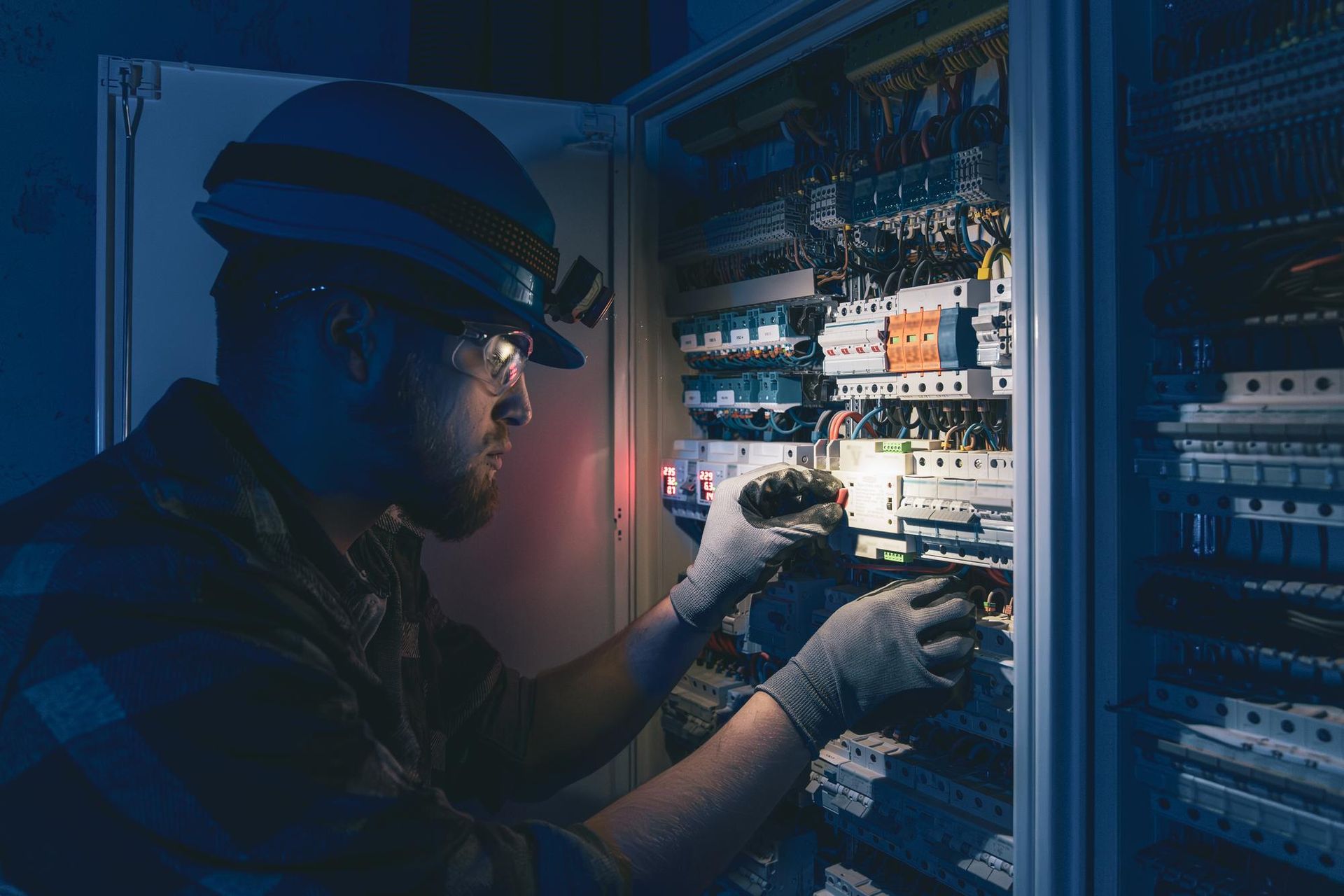
One of the most critical differences between LED and traditional lighting lies in energy consumption. LED lighting uses significantly less electricity compared to incandescent, fluorescent, or halogen bulbs. In fact, LED systems can reduce energy usage by up to 90%, which translates directly into lower utility bills for your commercial facility. Over time, the reduced energy demand not only decreases monthly operating costs but also contributes to sustainability efforts. Businesses looking to improve energy efficiency or achieve LEED certification often find LED upgrades to be a cost-effective, high-impact solution.