




Lighting that works: color, comfort, controls, and cost for better facilities
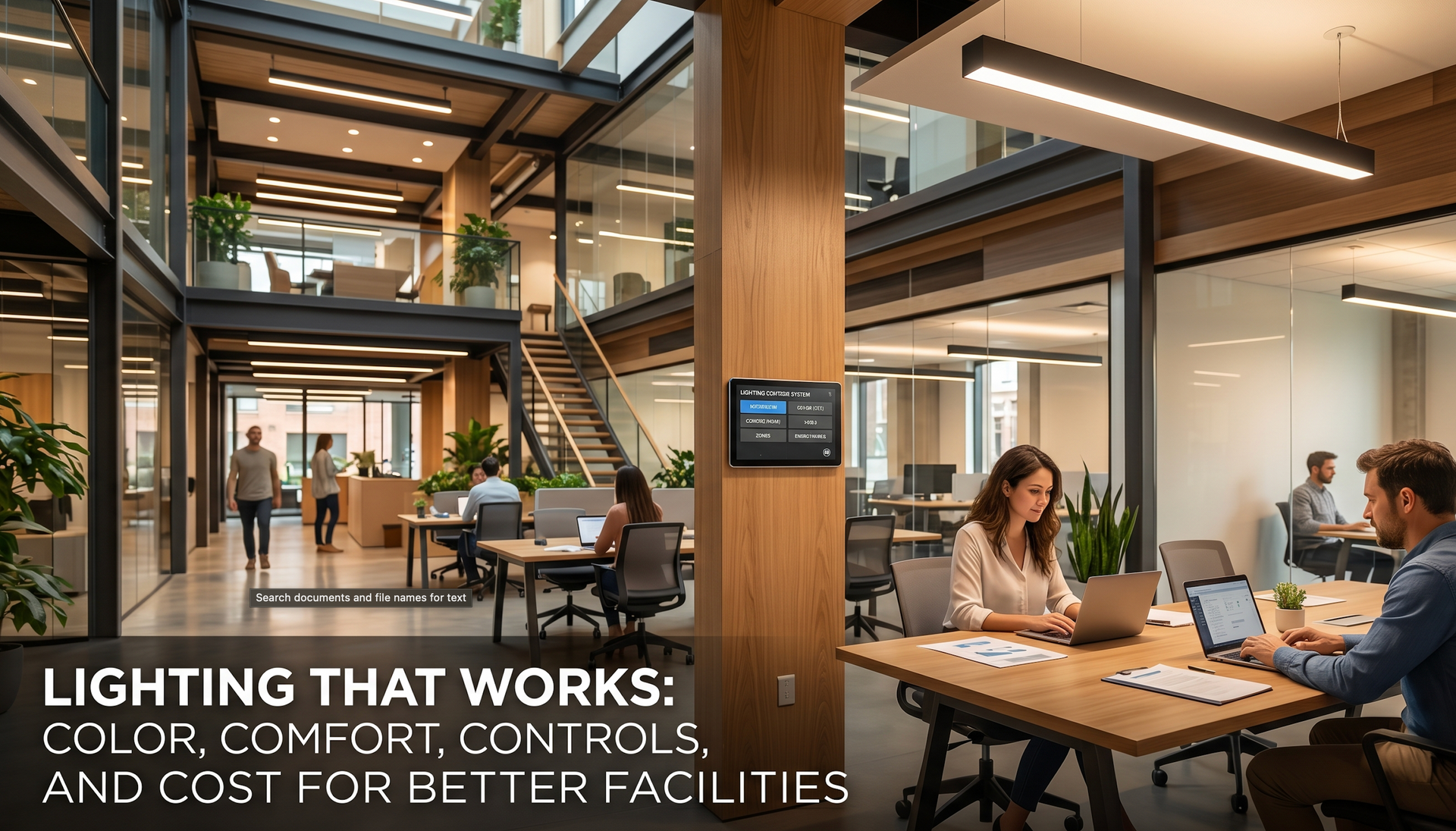
Good lighting is not about wattage alone. It is about giving people the right visibility with the least energy and the least distraction. When lighting is tuned to your tasks and space, occupants work better, feel safer, and your utility bill goes down.
This guide breaks lighting into practical pieces so non-engineers can make confident decisions. You will see how the four types of lighting build a complete system, why the four C’s matter, how to choose color temperature by application, and what to watch during a retrofit so you do not trade one problem for another.
If you manage offices, warehouses, clinics, or public spaces, use this as a checklist to align design intent with code, controls, and long-term maintenance.
The four types of lighting most facilities need
A complete lighting plan layers four functions so people always have the light they need, where they need it.
- Ambient lighting: The general, uniform light that lets you navigate a space. In offices this is usually troffers or panels. In warehouses it is high bays. Think base visibility.
- Task lighting: Focused light for a specific activity. Examples include under-cabinet lights at workstations, surgical task lights in healthcare, or supplemental lights over packing benches.
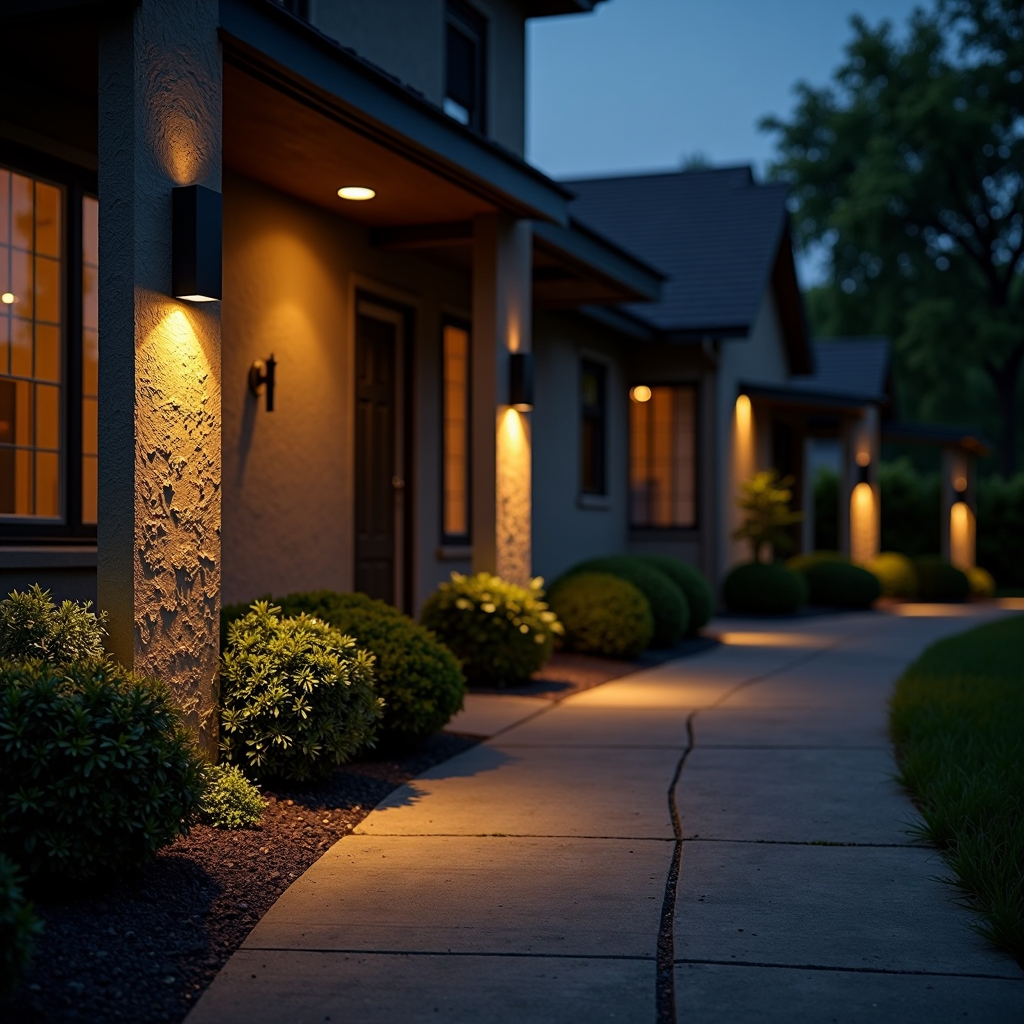
- Accent lighting: Targeted light to draw attention, shape perception, or support wayfinding. Wall washers on displays, uplights on signage, or highlights for architectural features.
- Emergency and egress lighting: Code-required illumination and exit signs that stay on or come on during power loss. This layer protects life safety and is tested on a schedule.
Plan all four layers together. If ambient is supplying too much light to compensate for missing task lighting, energy use climbs and glare increases.
The four C’s translated into outcomes
The four C’s are a simple framework that connects technical choices to real results: productivity, safety, energy, and satisfaction.
- Color: Two measures drive how people see. Color temperature (in Kelvin, K) is the visual “warmth” or “coolness” of light. Color rendering index (CRI) indicates how accurately colors appear versus a reference. Offices typically favor 3500K to 4000K with CRI 80 to 90 for balanced comfort and clarity. Healthcare exam areas often use 4000K to 5000K with high CRI for skin tone accuracy. Industrial inspection lines may require high CRI so defects are visible.
- Comfort: Glare control, uniformity, and flicker management reduce eye strain and headaches. Optics, diffusers, shielding, and correct aiming matter more than raw lumens. Comfort also means quiet drivers and controls that dim smoothly.
- Controls: Occupancy sensors, daylight harvesting, time scheduling, and task tuning cut wasted run hours. Good controls also stabilize light levels and extend fixture life. Controls should be planned with zones that match how people use the space.
- Cost: Look beyond unit price. Consider lifecycle cost, energy, maintenance, downtime risk, and available rebates. A well-designed LED and controls package often pays back through energy savings and reduced service calls while improving visibility.
4000K vs. 5000 to 6500K, and where they fit
Color temperature choice should follow the work being done, surface reflectance, and daylight availability.
- Offices and classrooms: 3500K to 4000K supports long-duration comfort and accurate reading on screens and paper. It reduces harsh contrast and perceived glare. 4000K strikes a neutral balance that suits most open offices and conference rooms.
- Warehouses and production floors: 4000K to 5000K improves contrast for reading labels at height and differentiating materials. Where skylights or clerestories bring strong daylight, 5000K can align perceived color with daylight. Pair with precise optics to keep light on aisles and work zones.
- Healthcare: Patient rooms often use 3500K to 4000K for comfort and recovery, with tunable options for night mode. Exam and treatment areas benefit from 4000K to 5000K and high CRI so clinicians can see detail and true color. Surgical settings may use higher CCT with very high CRI to improve tissue differentiation.
Which is “brighter,” 4000K or 6500K? Brightness is measured in lumens at the source and illuminance (lux or footcandles) on the task. CCT does not directly change lumen output, but higher CCT can be perceived as crisper, which some interpret as brighter. If you need more visibility, adjust lumens and optics to get target footcandles on the work plane, then choose CCT for comfort and accuracy.
CRI and visual accuracy
Color rendering index (CRI) is a 0 to 100 scale. Higher numbers mean colors look closer to how they appear under a reference source. For most commercial work, CRI 80 is adequate. For retail, healthcare, art, and inspection, CRI 90 can improve recognition of subtle differences. Remember that optical design, reflectance, and cleanliness also influence what people see.
Controls that save energy without annoying people
Poorly tuned controls cause complaints. Good controls are almost invisible to occupants.
- Occupancy and vacancy sensing: Use vacancy mode in private offices so lights only turn on when manually requested, and off when empty. In large open areas, occupancy sensors with time delays reduce false offs.
- Daylight harvesting: Photosensors trim output near windows to maintain a consistent target level. Calibrate per zone and keep sensors away from drafts or reflective glare.
- Task tuning and scheduling: Set maximum output per zone to match the task and cap over-lighting. Use schedules for common areas and exterior lighting, with overrides for after-hours use.
Plan sensor placement during design, not after installation. Commissioning is not optional. It is the step that makes the system work as intended.
Glare, optics, and visual comfort
Glare is lost time and complaints. Control it by selecting the right optics and applying light only where needed.
- Offices: Use diffusers or microprismatic lenses, maintain luminance limits within view angles, and coordinate light levels with monitor placement.
- Warehouses: Use narrow or aisle optics to put light on the floor and racking faces, not into eyes when operators look up.
- Healthcare: Shield sources in patient rooms to reduce direct view, and provide layered lighting for staff tasks without disturbing patients.
Photometric layouts validate that fixtures, optics, and spacing meet target footcandles and uniformity. This is where many retrofits fail when they swap one fixture for another without checking distribution.
Retrofit pitfalls and how TCL designs around them
Common issues in lighting retrofits are predictable and avoidable with planning.
- Mismatched optics: A panel may replace a parabolic troffer but produce more high-angle brightness and glare. Solution: run a quick photometric check and choose optics that match the task and ceiling height.
- Poor controls integration: New LED fixtures can flicker or fail to dim with legacy dimmers. Solution: verify driver compatibility, select a controls platform early, and commission zones after installation.
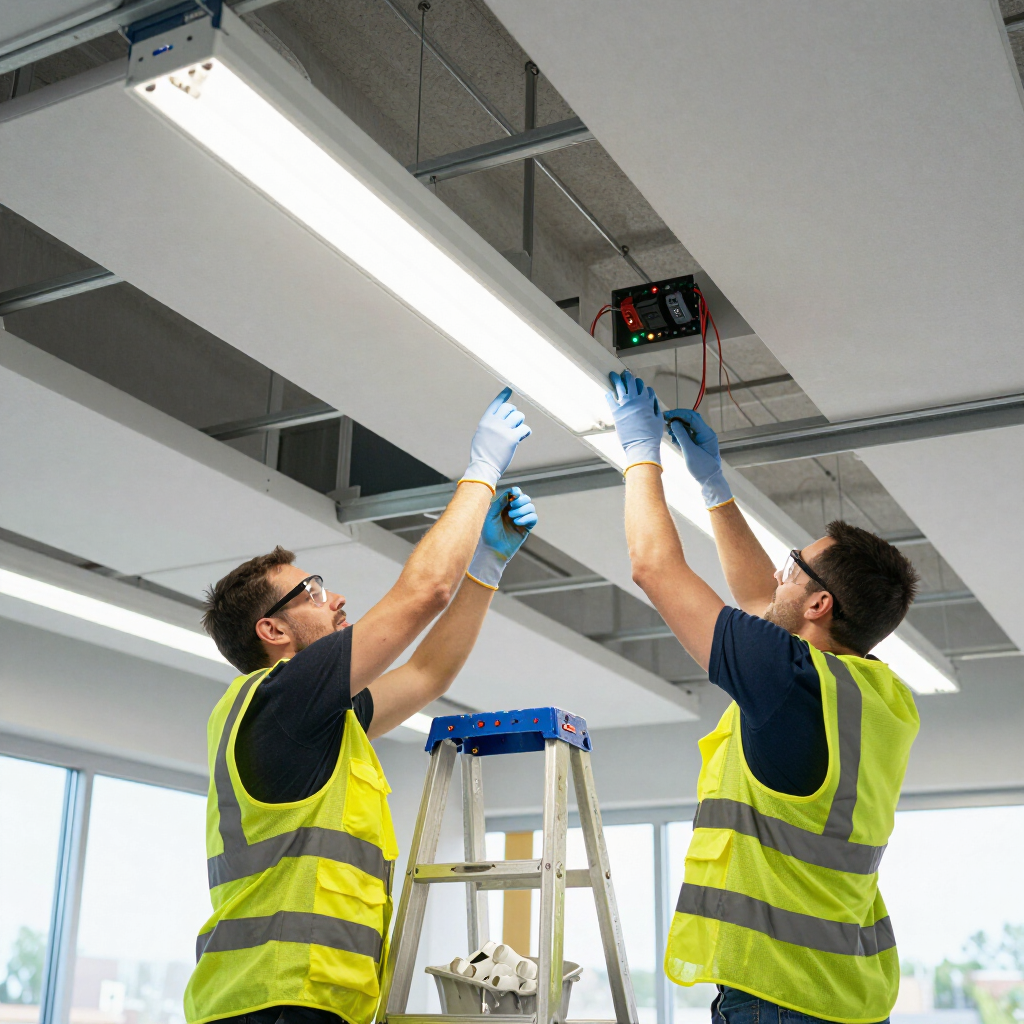
- Code and labeling gaps: Ballast-bypass (Type B) work without relabeling creates hazards. Solution: follow lockout/tagout, use listed components, apply required labels, and update single-line diagrams.
- Missed rebate eligibility: Some utilities require DesignLights Consortium (DLC) listings or specific control strategies. Solution: align product submittals with incentive rules before ordering.
- Over- or under-lighting: One-for-one swaps can swing levels 30 percent or more. Solution: adjust lumen packages and spacing to meet target footcandles, not just fixture count.
TCL Electrical & Lighting scopes retrofits with an energy-first and safety-first process: on-site audits, photometrics, color and CRI selection by application, controls design with commissioning, and documented code compliance. For regional support in and around Naperville, you can start with an audit through our page for lighting design and install in Naperville to plan an energy-efficient retrofit that is controls-ready.
Application snapshots
- Open office: 4000K panels or troffers with UGR-conscious optics, CRI 80 to 90, vacancy sensors in enclosed rooms, daylight zones at the perimeter, task lights at focus areas. Target comfortable reading levels on desks, not maximum brightness everywhere.
- High-bay warehouse: 4000K to 5000K high bays with aisle optics, high mounting height lumen packages, occupancy sensors by aisle, and daylight harvesting under skylights. Aim for uniform vertical illuminance on racking faces for pick accuracy.
- Clinic and patient areas: 3500K to 4000K ambient with high CRI task lighting at exam zones, dimmable night settings, and dedicated egress coverage. Controls sequences should prioritize patient comfort and staff visibility.
If you need localized commercial support, our Naperville commercial electricians can align fixture choices, controls, and code needs with your operating schedule.
Quick FAQ
- What are the four types of lighting? Ambient, task, accent, and emergency/egress.
- What are the four C’s of lighting? Color, comfort, controls, and cost. Together they link visual quality and energy to outcomes like productivity and safety.
- Which is brighter, 4000K or 6500K? Neither by CCT alone. Brightness is lumens and illuminance on the task. Higher CCT can feel crisper, but verify footcandles and choose CCT for comfort and accuracy.
- What is the best type of lighting for a house? Residential spaces usually favor warm to neutral white (2700K to 3000K for living spaces, 3000K to 3500K for kitchens and baths) with good glare control and dimming. For this article’s audience, apply the same principle in amenity areas or model units, but tune for the task and occupant comfort.
- What are the disadvantages of retrofitting? Risks include mismatched optics and glare, controls incompatibility, code and labeling issues with ballast-bypass work, missed rebates, and over- or under-lighting. A structured audit and design process prevents most of these.
How to start with TCL
A short site walk and energy audit will identify the right CCT, CRI, optics, and controls for each space, plus your rebate path and phased schedule. If you manage facilities near Naperville and need help planning energy-efficient lighting installation in Naperville with controls integration and commissioning, our team can help. For plants and campuses in Batavia, explore high-efficiency fixtures in Batavia to convert legacy systems to LED with proper labeling and code compliance.
Summary and next step
Effective lighting is layered, comfortable, controllable, and cost-aware. Choose CCT and CRI by task, control glare with the right optics, and let smart controls cut waste without disrupting people. Avoid retrofit pitfalls by validating optics, documenting wiring changes, integrating compatible controls, and aligning with incentives.
Request a lighting assessment with a controls-ready retrofit plan. TCL Electrical & Lighting will model light levels, recommend optics and color, specify compatible controls, and map a phased path to energy savings with clear compliance and commissioning.